
Long-Term Culling Study Does Not Support Pen Study Results
Publisher
Colleen Schreiber, Livestock Weekly
SAN ANTONIO — Big bucks offer big bucks, especially in Texas.
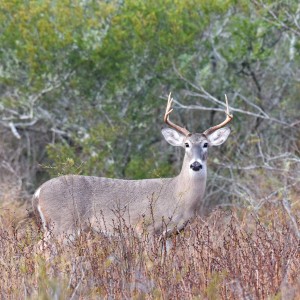
How to make bigger antlered whitetail deer is something that deer enthusiasts spend a lot of money and a lot of brain power thinking about. Culling has long been one of the tools promoted by wildlife biologists.
Dr. Charles DeYoung discussed some of the mechanics and effects of culling on the age structure and Boone and Crockett (B&C) scores specific to two long-term research studies spanning 20 years at the recent Caesar Kleberg Wildlife Research Institute’s (CKWRI) annual Deer Associates gathering.
Both studies were designed by Texas Parks & Wildlife Department (TPWD). The King Ranch study done in Kleberg County was funded by the King Ranch and second study conducted on the Comanche Ranch in Maverick and Dimmit counties was funded by the Comanche Ranch. CKWRI provided scientific background and support for the study with a host of students and scientists involved in the actual field work.
As DeYoung explained, the motivation for the studies centered around the fact that there had been many pen studies done on deer genetics, many of which were carried out at the Kerr Wildlife Management Area (WMA), west of Kerrville. However, there had not been extensive, intensive, long-term studies in the field to validate the pen studies. Thus, a host of scientists from CKWRI and TPWD as well as numerous students and biologists from the respective ranches teamed up to try and do that very thing.
DeYoung pointed out that the results of many of the pen studies recommended the culling of young bucks considered inferior.
“It was either implied or stated that culling could lead to genetic improvement in managed deer populations,” said DeYoung.
Initially, the results of these pen studies also led some deer biologists to recommend harvesting spikes because they were deemed inferior. Later biologists at the Kerr WMA began recommending the culling of yearling deer with less than six antler points. These were some of the recommendations that the field study looked to validate or invalidate.
The objective of the King Ranch study, initiated in 1999 and finished up in 2005, was to see if culling could increase the Boone and Crockett score of age classes in the population being studied.
“Changing the Boone and Crockett score of the sires is a prerequisite for any kind of genetic change,” said DeYoung. “In other words, the breeding males have to be bigger if there is going to be a genetic change to bigger antlers.”
There were two study areas, each encompassing about 9400 acres, both under low fences. Culling was done by rifle during the legal hunting seasons from 1999 through 2004, but monitoring continued through 2005.
The culling criteria were to cull yearlings with less than six points and older deer with less than nine points.
“This is more aggressive than had been recommended based on the pen studies at the Kerr WMA because we were culling all age classes, not just yearling deer,” DeYoung explained.
Buck captures were done annually to compare against cull animals and to estimate population size. All bucks were pit tagged and released.
There were 135 bucks on the treatment area harvested over the course of six years based on the preset culling criteria, and 33 additional bucks were harvested by the ranch’s recreational hunters. In all the annual average harvest rate was 8.6 percent.
On the control area, 11 bucks were harvested over the six-year study period.
As for buck captures, 436 were captured on the treatment area of which were 69 recaptures. On the control area 300 were captured including several recaptures.
For the results, he shared a bar chart of Boone and Crockett scores by age class versus the control area. For the yearlings harvested, the B&C score was significantly different. B&C scores, however, were not different in the two-year-old category.
“The culling criteria of less than nine antler points was not good for the two-year-olds,” said DeYoung.
In essence, the culling criteria was too restrictive because nearly all two-year-olds were being culled.
It worked well, however, for the three and four-year-olds, but it “wasn’t great” for five years and older category. On the latter DeYoung attributed it to the recreational harvest in the sample set.
Another graph showed deer density trends on the treatment area. There was no difference in density across age groups meaning that culling had no impact on deer density across age classes. However, he noted that there was an unexplainable difference in that the deer density on the treatment area was higher compared to the control.
Specific to the sex ratio, results were inconclusive. Looking at B&C scores across age groups, culling also had no effect.
An important concurrent study, published in the Journal of Wildlife Management, showed the significance of buck dispersal. In general, the way the study was designed was that yearling bucks captured were radio collared and followed over a specified time.
What researchers found was that 23 percent of the yearling bucks dispersed, some moving several miles from their natal area, DeYoung said. Others termed “wanderers” increased their home range size, but they went back to the original area occasionally while the non-dispersers stayed within their natal home range.
The results of this study were critical because it emphasized the difficulty in using culling for genetic change in low-fence operations.
“These disperser bucks were mixing with other deer over a large area, and presumably other bucks from surrounding areas were also dispersing into an area,” said DeYoung. “So, it’s very hard to put pressure on antler size with all this mixing going on.”
Still, another concurrent genetics study in which DNA was collected from captured bucks revealed still more interesting results. From this study, researchers learned that bucks three years of age and older sired 70 percent of the fawns and the young bucks, collectively, sired 30 percent of the fawns.
DeYoung also pointed to another important study, a modeling study, this one done in Mississippi. This study found that a 50 percent cull harvest rate was needed to change average antler size of the population. The annual cull harvest rate for the King Ranch study was only 8.6 percent, he reminded.
A list of lessons learned from the King Ranch study was offered. First, DeYoung pointed out that it was very difficult to attain a high harvest rate experimentally using rifle hunters.
“We would recommend culling at capture for experimental purposes.”
Second, a high fence area is needed to prevent dispersal of bucks or other outside bucks from coming in.
Third, a much higher harvest rate is needed.
Fourth, the culling criteria for the two-year-old and the mature bucks needed tweaking.
Finally, a genetic evaluation of the results is needed to indicate which bucks were siring fawns and the relationship between antler size of the male offspring relative to his sire.
This led researchers then to initiate another study, this one on the Comanche Ranch. Three treatments were established.
The intensive treatment encompassed a 3700-acre high fenced pasture. The moderate treatment was a very large area, encompassing 19,000 acres, of which 85 percent was high-fenced. The control pasture was 5000 acres in size and completely high-fenced. All areas were heavily supplementally fed 10 months of the year with a feeder every 70 to 90 acres.
Culling was conducted from 2006 to 2012, but monitoring continued for an additional six years. In the intensive treatment the culling criteria was the same as the King Ranch study with yearling bucks with less than six antler points being culled. Culling in the two-year-old class was more aggressive than the King Ranch study with those bucks with less than eight antler points being culled. The culling standards for three and four-year-olds was the same as the King Ranch study with those having less than nine points being culled. However, for the mature deer culling was more aggressive. In this age class bucks with less than a 145 gross B&C score were culled.
In the moderate treatment, no culling was done with young deer, the yearlings, 2.5-year-olds but the culling criteria for the 3.5-year-olds and up was the same as in the intensive treatment with 3.5-4.5 year-old bucks with fewer than nine antler points being culled and those 5.5 years of age and older with a B&C score less than 145 points being culled.
On the control area no bucks were culled. He also pointed out there was “very light” recreational hunting on all three treatments.
Buck captures, done to compare the deer that were culled, were conducted one day a year on the control and the intensive control pasture for 13 years and on the larger moderate study area three days a year for 13 years.
All bucks were aged and B&C scored. For those that exceeded the cull criteria, a genetic tissue was collected for genetic analyses and then they were pit tagged and released.
Bucks meeting the culling criteria were euthanized on site with a captive bolt gun. He noted again that after the seven years of culling, captures continued for an additional six years through 2018 to enable the fawns born after the culling treatment ended to mature.
In all, 6600 bucks were captured during the study, of which about half were recaptures. Of that total 365 were culled for an average annual harvest rate of 48 percent, said DeYoung. He reminded that the Mississippi study recommended a 50 percent harvest rate to make genetic change.
“We hit that on the intensive treatment,” he told the group.
In the moderate area, 878 bucks were culled for a 19 percent annual harvest rate.
As for results, on the intensive area looking at culled bucks versus captured bucks there was a significant difference across all age classes. Specifically, there was a significant difference between the culled deer and the standing crop. The same was also true on the moderate treatment.
As for population density, meaning bucks per square mile, the buck population was significantly reduced on the two treatment areas. However after culling stopped, the buck populations increased.
Additionally on the intensive area, the culling treatment caused a very skewed sex ratio. At the end of the culling period, it was about one buck to six does.
He also shared what he referred to as “transition frequency” which showed basically that the keeper deer tended to become culls as they aged.
“Remember we were culling the mature bucks based on B&C score,” DeYoung told the group. “The B&C score tended to decline as they got older which moved them into the cull category.”
More significant results relating to the B&C scores from culling showed that on the intensive area at the end of the culling period, there was no difference between the control yearlings and the yearlings in the intensive treatment.
However, at the end of the study, after six years of no culling, there was a significant difference in yearling B&C scores in the control versus the intensive treatment. Specifically, the yearling bucks in the intensive treatment had smaller antlers thus a lower gross B&C score. The same results were found for the 2.5-year-old deer.
However, the 3.5 to 4.5-year-old bucks had larger antlers, on average about 10-inches larger, compared to the control pasture at the end of the culling period. By the end of the study, however, after no culling for six years, the antlers were smaller, said DeYoung.
For the mature deer, those 5.5 years of age and up, the gross B&C score was higher for the mature deer on the intensive area compared to the control when culling stopped. However, at the end of the study, unlike the other age classes, there was no difference in B&C scores of bucks in the control compared to those in the intensive treatment.
On the moderate treatment, at the beginning of the study the gross B&C for the 1.5-year-old deer was higher compared to those in the control. It was not higher though at the end of the culling period. Also, at the end of the study antler size was smaller, meaning lower gross GBC scores.
The same was true for the 2.5- and 3.5-4.5-year-olds. However, for the mature deer the antler size was larger at the end of the culling period for those in the moderate treatment, but at the end of the study, six years post culling, there was no difference between the mature bucks in the moderate treatment site versus those in the control.
DeYoung wrapped up by reiterating lessons from the Comanche Ranch study. First, culling increased the antler size in two age classes, the older classes, on the intensive culling treatment. However, six years post culling antlers were smaller or there was no difference in the intensive treatment area compared to the control.
Likewise on the moderate treatment, culling increased the antler size by about four inches in the mature deer, but six years after culling stopped there was no difference in antler size.
“Looking at Boone and Crocket scores as the measurement of improvement, this study did not show any evidence of genetic improvement even though antler size in some age classes increased at the end of the culling period.”
Bottom line, big picture, long-term intensive culling did not result in deer with larger antlers in subsequent generations.
The results of the two field studies, the King Ranch study and the Comanche Ranch study, have been combined into a monograph. It was peer reviewed by four scientists, experts in this field, two from the U.S., one from Canada and one from Australia and was accepted for publication in Wildlife Monographs. The monograph, which will be available online in a couple of months, will be open for viewing to everyone.